


So, What Is a Copywriter? Here’s What We Really Do
- Jennifer Johnson

- May 13
- 5 min read
Updated: Jul 15
When I first told my family I was going to be a copywriter, they thought I meant copyright.
There was a short-lived moment where they genuinely believed I was becoming a lawyer. I think they were quite proud. (Sorry, Mum.)
That mix-up’s a common one, and it’s not the only time I’ve had to explain what a copywriter actually does.
So if you’re wondering the same thing, whether out of curiosity, because you’re thinking of becoming one, or because you’re trying to figure out if your business needs one, you’re in the right place.
Let’s take a look at what copywriting really is, what it involves day to day, and why it shows up in more places than you might expect.
What Does a Copywriter Do?
Copywriters write the words businesses use when they want to sell something, explain something, or connect with their customers.
That might be:
The text on a website
A product description
An email campaign
An advert
A tagline
A page that tells someone what to do next
The goal is always the same: to communicate something clearly, and in a way that feels right for the people reading it.
Some projects are more creative, such as shaping the tone of voice for a new brand or coming up with a headline that actually makes someone stop and read. Others are more practical, such as writing helpful product information or editing an FAQ page so it’s clearer.
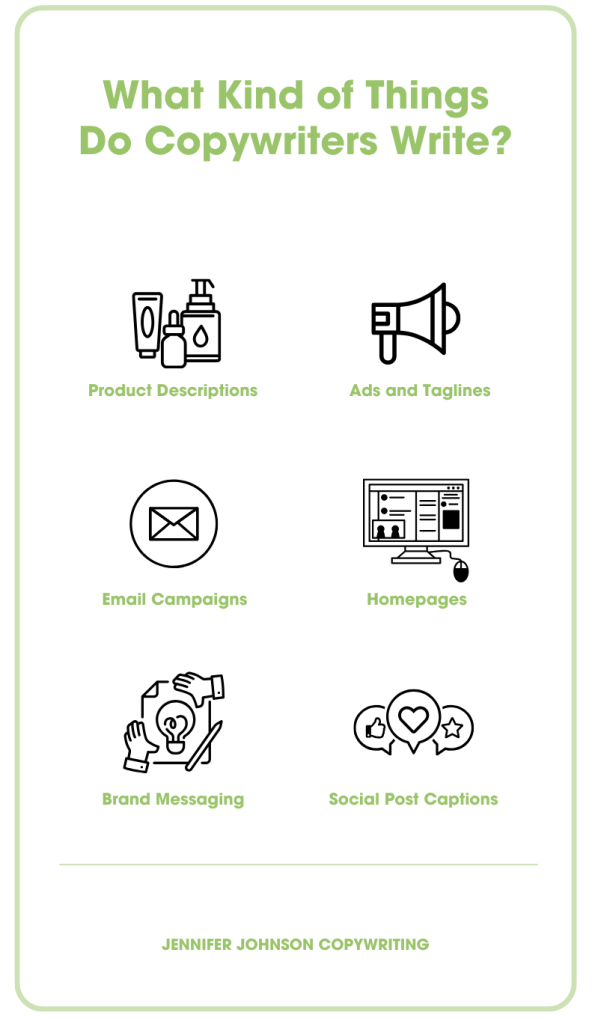
What Kind of Things Do Copywriters Write?
This depends on the project, the business, and the customer, but copywriters are usually brought in to write the words that appear around a product or service.
Here are some examples:
Websites – Homepages, About pages, product pages, landing pages, FAQs
Emails – Welcome sequences, sales emails, newsletters, abandoned cart reminders
Product descriptions – Especially for e-commerce stores that want each item to feel considered
Campaigns – Launch messaging, seasonal promotions, customer journeys
Social media and ads – Captions, headlines, CTAs, and sometimes the messaging behind a whole series
Brand messaging – Tone of voice guidelines, taglines, brand story copy
Some writers specialise in one thing (like email or e-commerce). Others work across a few areas. Some are strategists too — helping shape the messaging from the ground up. You might also find lots of copywriters (like me) write blog posts too, though some would argue this is more defined as content writing — which I will discuss in a moment.
But in every case, the copy has a job to do.
It’s there to help a business say the right thing, in the right way, to the right people.
FAQs About Copywriting

Is copywriting the same as content writing?
They’re closely linked, but technically not quite the same.
Content writing is usually longer-form — things like blog posts, how-to guides, and articles that are there to inform or support.
Copywriting is more focused on helping someone take action — buying something, signing up, making a decision.
A lot of writers (me included) do both, depending on the project.
Keen to learn more? I’ve covered the topic here.
Do copywriters need to know marketing?
A little, yes — especially how people make decisions and what makes a message land. You don’t have to be a full-blown strategist, but understanding the bigger picture definitely helps.
Do I need a degree to become a copywriter?
Not at all.
Some people come from comms, journalism, or marketing. Others come from completely different backgrounds: retail, customer service, law, design, teaching, or just a general love of writing.
There’s no one path in.
Is copywriting just writing what the client says?
Not quite. Clients bring the knowledge, but part of the job is working out what really needs to be said, and how to say it clearly.
Sometimes the message is already there and just needs shaping. Sometimes it needs pulling out from scratch.
Do I need to have everything figured out before I hire a copywriter?
Not necessarily, as part of our job is helping you get clarity.
Some clients come to me with a full brief. Others show up with a single sentence and a feeling of “I don’t know where to start.”
Either way is fine.
Is AI going to replace copywriters?
It’s definitely changing the industry, but there’s still a big difference between something that sounds okay and something that actually works.
Copywriters bring the context, the questions, the tone, the care. That still matters.
If there’s something else you’ve always wondered about copywriting, feel free to ask. No silly questions here!

What’s It Like to Work With a Copywriter?
It’s a bit different for every project, but most collaborations follow a similar rhythm.
We start by talking. By email, phone, or video call — whichever feels most comfortable for you.
You tell me about your business: what you do, what you offer, who it’s for, and what you need help with. I’ll probably ask a lot of questions. (Not to be nosy, just to make sure I actually understand what matters.)
From there, I’ll go away and do the writing, based on everything we’ve talked about. You’ll get to review it, give feedback, and make sure it all feels right. It’s a collaborative process, not a handover.
In a nutshell, here’s how it usually works:
We chat about what you need
I ask questions to get to the heart of it
I go away and do the writing
You review it and share your thoughts
We shape it into something that feels right for you, and useful for your customers.
Simple, collaborative, and designed to take the pressure off.
Could You Be a Copywriter?
If you’ve ever found yourself rewriting something in your head (for example, an email, a website, even a line on a menu), you might already think like a copywriter.
What matters most is curiosity — about how people think, what helps them decide, and how to say something in a way that actually works.
If you enjoy writing, and you like figuring out what to say and how to say it, copywriting might be something to explore. And even if you’re not looking to become a writer yourself, it can be helpful to understand how copywriters think.
Because behind every bit of writing, there’s usually someone asking:
Who’s reading this?
What do they need?
And what would actually make sense to say right here?
That’s the heart of the job; whether you’re writing it, reviewing it, or working with someone who does.
Wrapping Up
Copywriting often works quietly in the background; shaping how we understand things, make decisions, and connect with the businesses we choose to buy from.
It’s thoughtful, practical work. Sometimes creative. Sometimes strategic.
Sometimes it’s just finding the right handful of words, and getting them in the right order.
Whether you’re looking to work with a copywriter or become one, I hope this gave you a clearer sense of what the job really involves, and why it matters more than it often gets credit for.
And if you’re ever looking for someone to help with your website content, blog posts, or product descriptions, I’d love to hear from you.

Comments